Chunking: How to Remember Longer Number Sequences Instantly
Your short-term memory holds about 7 items — but an item can be a chunk. How grouping turns 1385729 into one thing, and how far the technique actually scales.
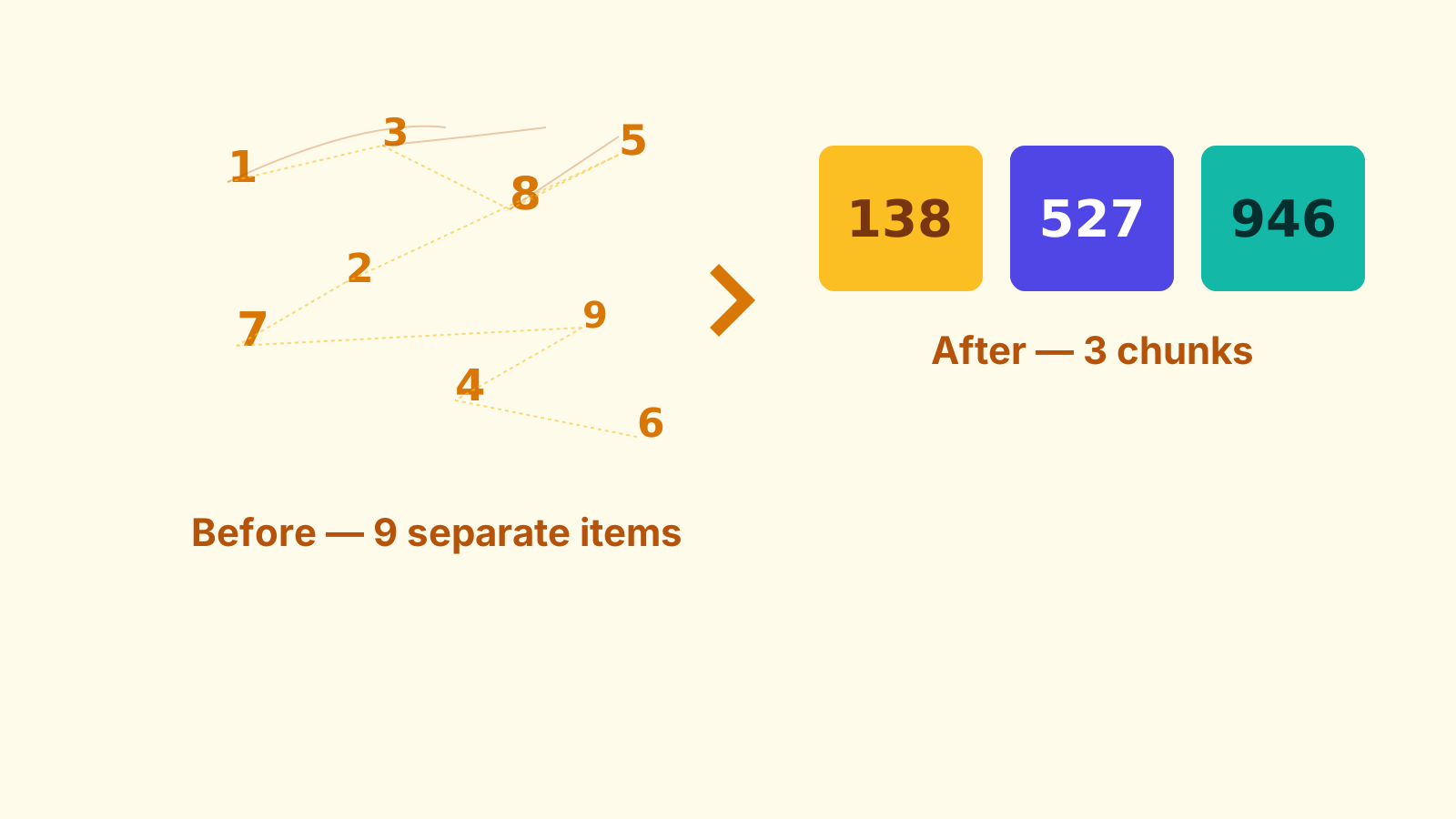
Read this once, look away, and repeat it: 7 2 9 4 1 8 3 6 5. Hard. Now try: 729 418 365. Easier, right? Nothing changed about the digits or their order. The only difference is how your brain packaged them. That packaging is called chunking, and it is the single most reliable free upgrade available to your short-term memory.
Why it works: seven chunks, not seven digits
The capacity limit from the 1956 Miller paper was never really "seven digits." It is roughly seven meaningful units. A unit can be a single digit — or a recognizable block. Your phone number already works this way: nobody stores eleven separate digits, they store three or four groups. A chess study from the 1970s showed masters reproduce mid-game board positions almost perfectly while beginners flounder — not because masters have better raw memory, but because a board full of familiar patterns compresses into a handful of chunks. On boards with randomly scattered pieces, the advantage mostly vanishes.
Three chunking strategies for digit training
- Plain grouping: split the sequence into 3-digit blocks. 8 digits become 3 items. This alone lifts most people from span 7 toward span 9–10.
- Familiar-number anchors: convert chunks into things you already know — a chunk 198 is a birth year, 315 is March 15, 611 becomes room 611. Familiarity makes a chunk compress further.
- Major System (advanced): map digits to consonant sounds, build words and images. With practice, trained users hold 20–30+ digits this way. The price is that it is a learned skill, not an instant trick.
Where chunking stops helping
Chunking is compression, and compression needs patterns. Random digits with no recognizable structure only tolerate grouping, not deep encoding — which is why raw digit span caps around 9–10 for most people even after chunking practice. Expert memorizers look superhuman, but inspect their technique and you always find a pre-built encoding system, not bigger innate storage. You are not stuck at 7 because your memory is small; you are stuck because you are storing digits in the most expensive format possible.
A one-week experiment
Next time you train, do not try harder to remember — try differently. Group the flashed sequence into blocks the moment it appears, say the blocks (not the digits) back to yourself, and type them. Do this every round for a week. Many people find longer sequences feel more manageable after just a few sessions — that change is packaging efficiency, not a bigger innate memory, and results vary from person to person. The habit itself tends to stick, because it changes how you handle every number you meet.