What Is a Digit Span Test? How It Works and What It Measures
Forward span, backward span, and why psychologists have used this simple number-recall task for over a hundred years. Plus what your score does and does not say about you.
A digit span test is almost embarrassingly simple: someone reads you a list of digits, one per second, and you repeat them back. Start with three or four digits, add one each round, and your "span" is the longest list you can reproduce correctly. It has been a standard item in clinical memory assessment since the early 1900s and remains a core part of the WAIS intelligence battery used today.
Forward vs backward span
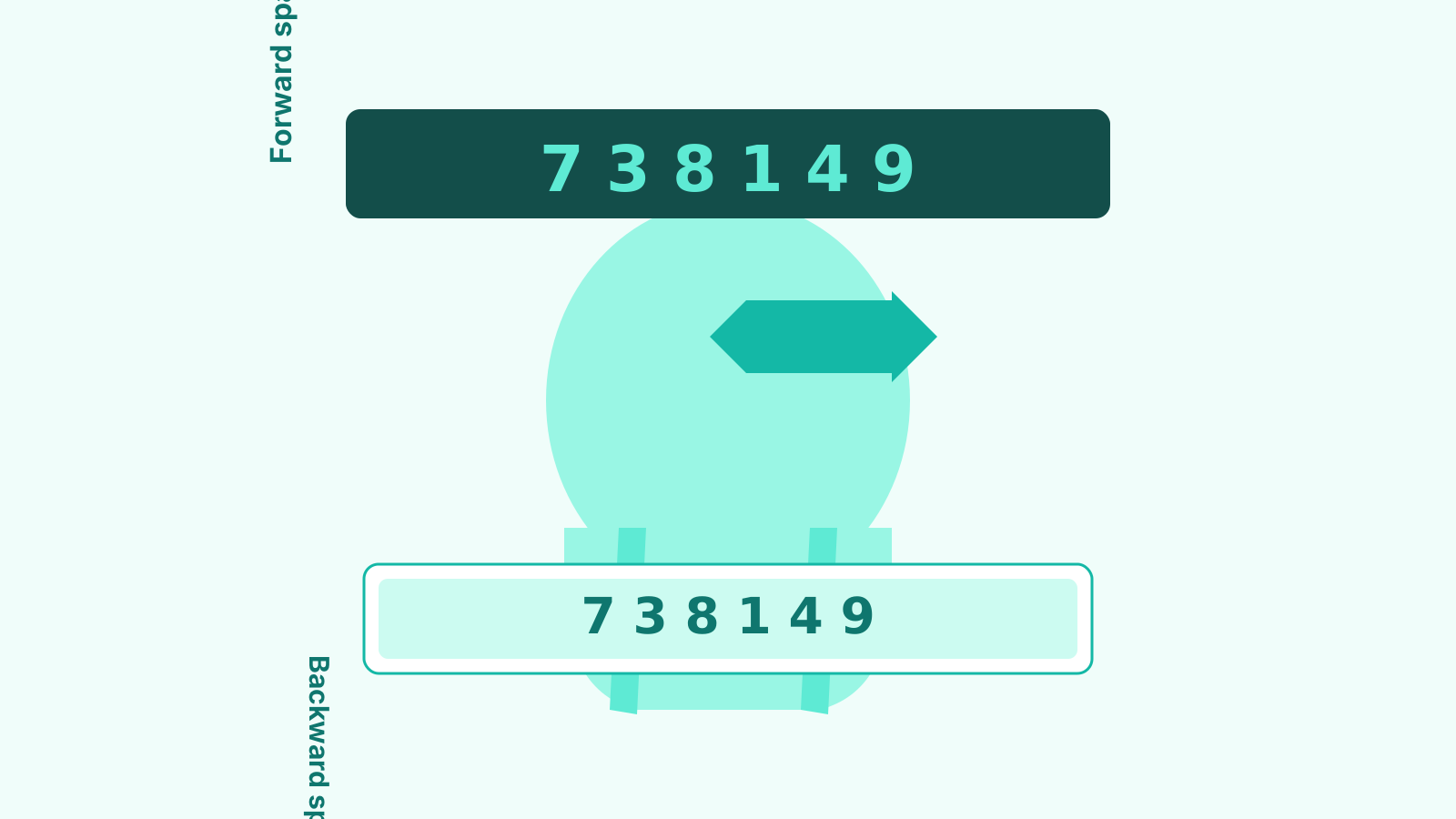
In forward span you repeat the digits in the same order — this is mostly a short-term storage task. In backward span you repeat them in reverse order, which forces you to hold the list and mentally rearrange it. That extra manipulation is why backward span is considered closer to a working-memory measure and why most people score one to two digits lower on it.
What a typical score looks like
For adults, forward span averages around 6–7 digits. The famous "seven plus or minus two" paper from 1956 placed this number at the center of cognitive psychology, and despite decades of quibbling, 6–7 remains the practical adult mean. Healthy teenagers and adults usually land in the 5–9 range. Backward span averages about 5. If you score 4 forward repeatedly, that would be low enough for a clinician to ask follow-up questions — but a browser game is not a clinical setting, so treat that as "worth practicing," not a diagnosis.
What it actually measures
- Phonological storage — you mostly hold digits as sounds, which is why saying them aloud as they appear helps.
- Attention control — encoding a sequence requires you to resist everything else happening on screen.
- Basic manipulation capacity — heavily taxed by the backward version.
It does not measure your overall intelligence, your long-term memory, or how "smart" you are in any meaningful everyday sense. People with incredible faces-and-names memory can have average digit spans; mathematicians are not automatically good at it. It measures one narrow, well-defined component.
Why the test refuses to die
Because it is cheap, fast, repeatable and surprisingly stable. Your span does not move much from Monday to Tuesday, which makes it a useful baseline; when it does move — from fatigue, illness, stress, or training — the change means something. Clinicians use drops in digit span as an early signal that something is off; trainers use the same stability to check whether practice generalizes.
If you take one thing from this: treat your span as a trainable skill with a fairly stable personal baseline, not an IQ verdict. Test it, note the number, practice for a month, test again. The change over time tells you more than any single score.