Training Your Prefrontal Cortex: What Actually Works
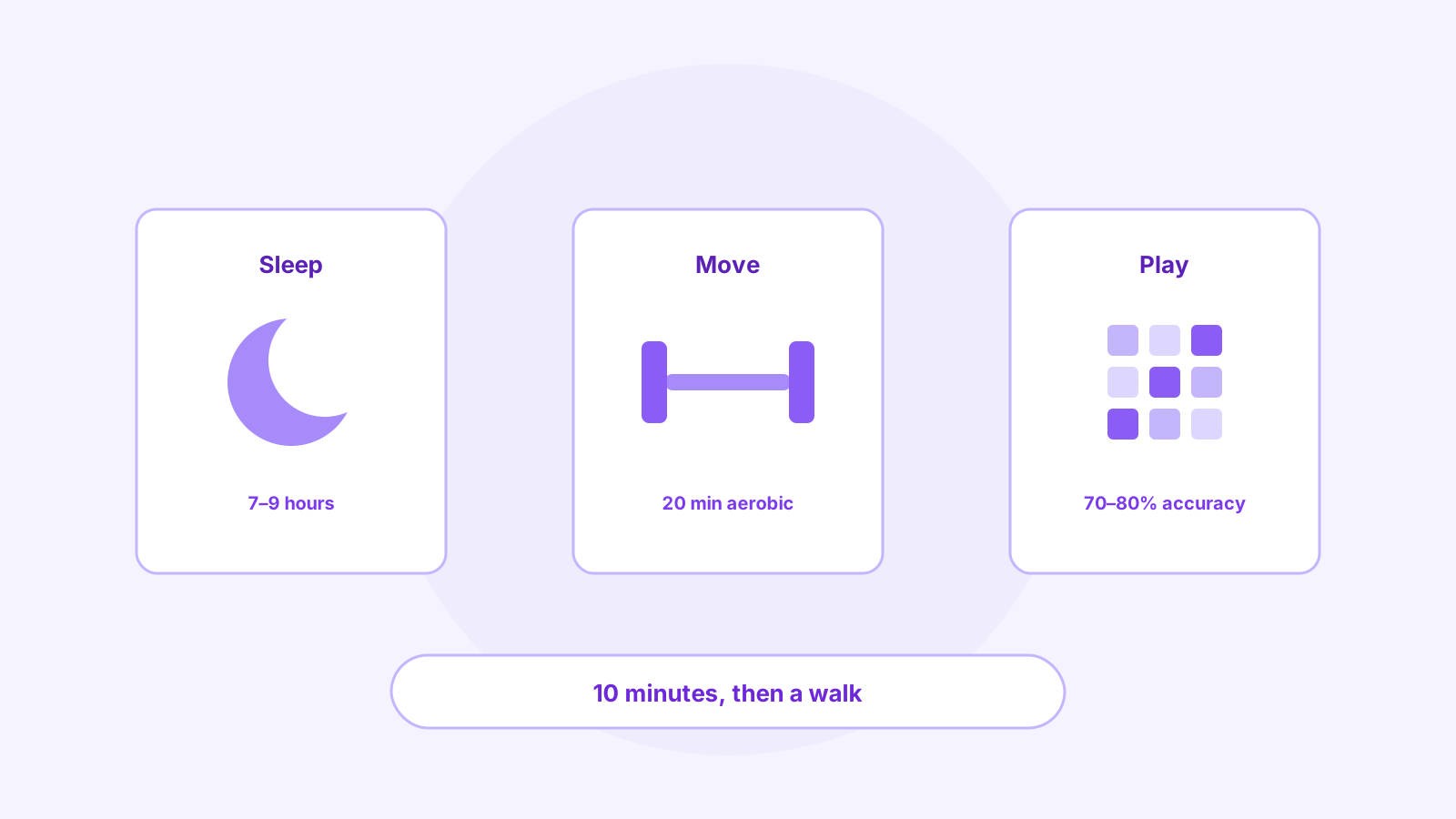
Most prefrontal training advice skips the boring levers. Sleep, aerobic movement, and difficulty pitched just past comfortable do more than any app — games included. Here is how to put them together in ten minutes.
Search for prefrontal cortex training and you will find a lot of apps, a few supplements, and almost no mention of the two interventions with the strongest evidence behind them: sleep and aerobic exercise. That is not because those are unglamorous. It is because nobody can sell them.
The two levers that keep showing up
Short sleep degrades exactly the functions that depend on prefrontal cortex: sustained attention, working memory, emotional control. A single night of total deprivation is enough to weaken prefrontal-amygdala coupling and let emotional reactivity run higher than it should (Yoo et al., 2007). You do not need a perfect eight hours, but you do need a consistent floor. Training attention on five hours a night mostly measures sleep debt.
Aerobic exercise has a similar pedigree. Hillman and colleagues (2008) found that twenty minutes of moderate treadmill walking improved response accuracy and P300 amplitude — an index of how much attentional resource gets allocated — in children. A meta-analysis of 36 studies (Ludyga et al., 2016) reported small but reliable post-exercise gains in executive function. The effect is modest. It is also repeatable, which is more than most commercial brain training can claim.
Where the games fit
Near transfer is real. Practise a task and you improve at that task, and usually at close variants of it. That has value: if your work involves scanning a dense dashboard, a Schulte grid is a reasonable proxy, and getting better at the grid will probably show up as getting better at the dashboard. Far transfer — to memory, reasoning, school performance — is where things thin out. Owen et al. (2010) found none after six weeks of online training in more than 11,000 participants. Melby-Lervåg and Hulme (2013) found working memory gains that did not survive much beyond the trained tasks.
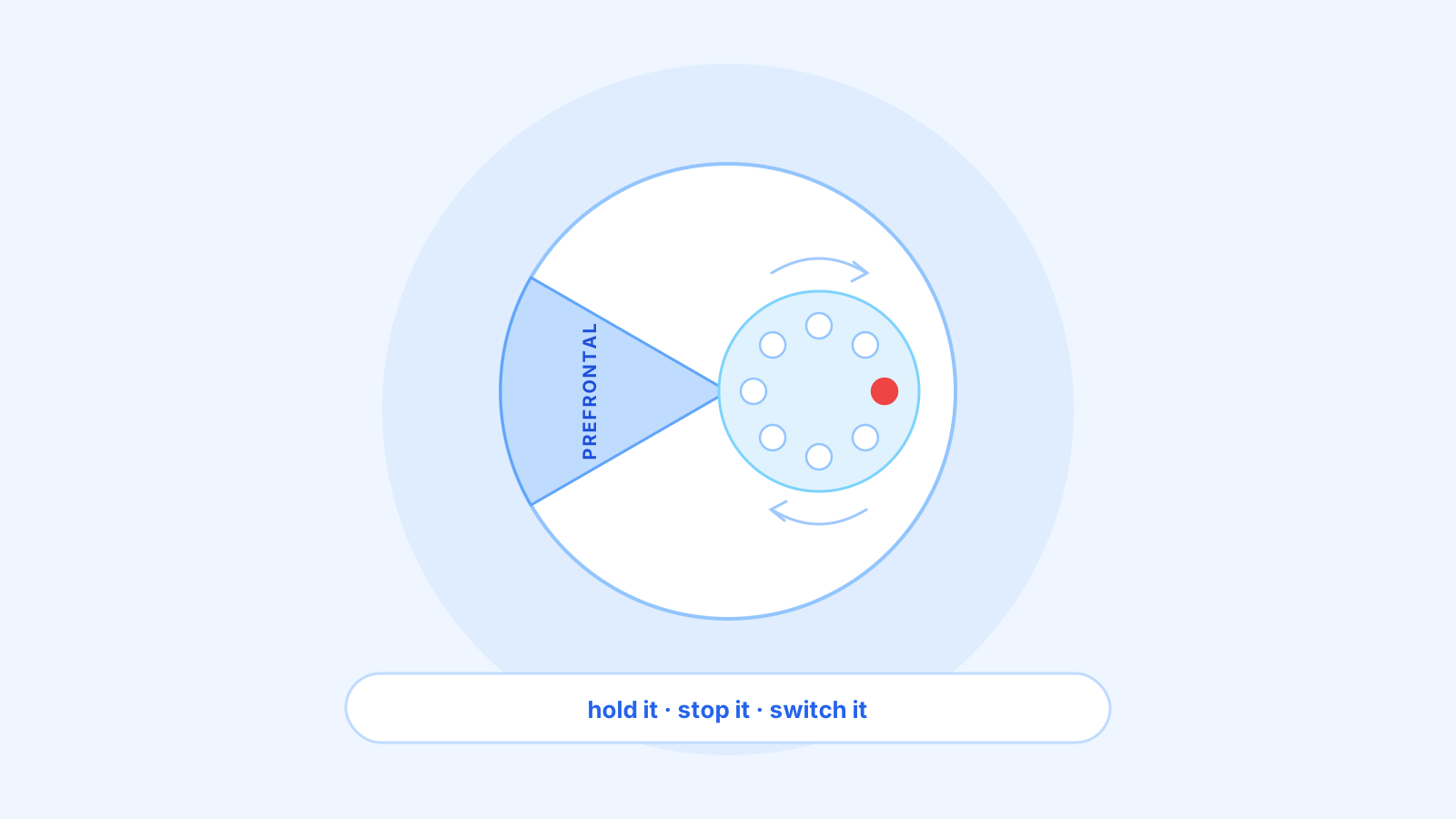
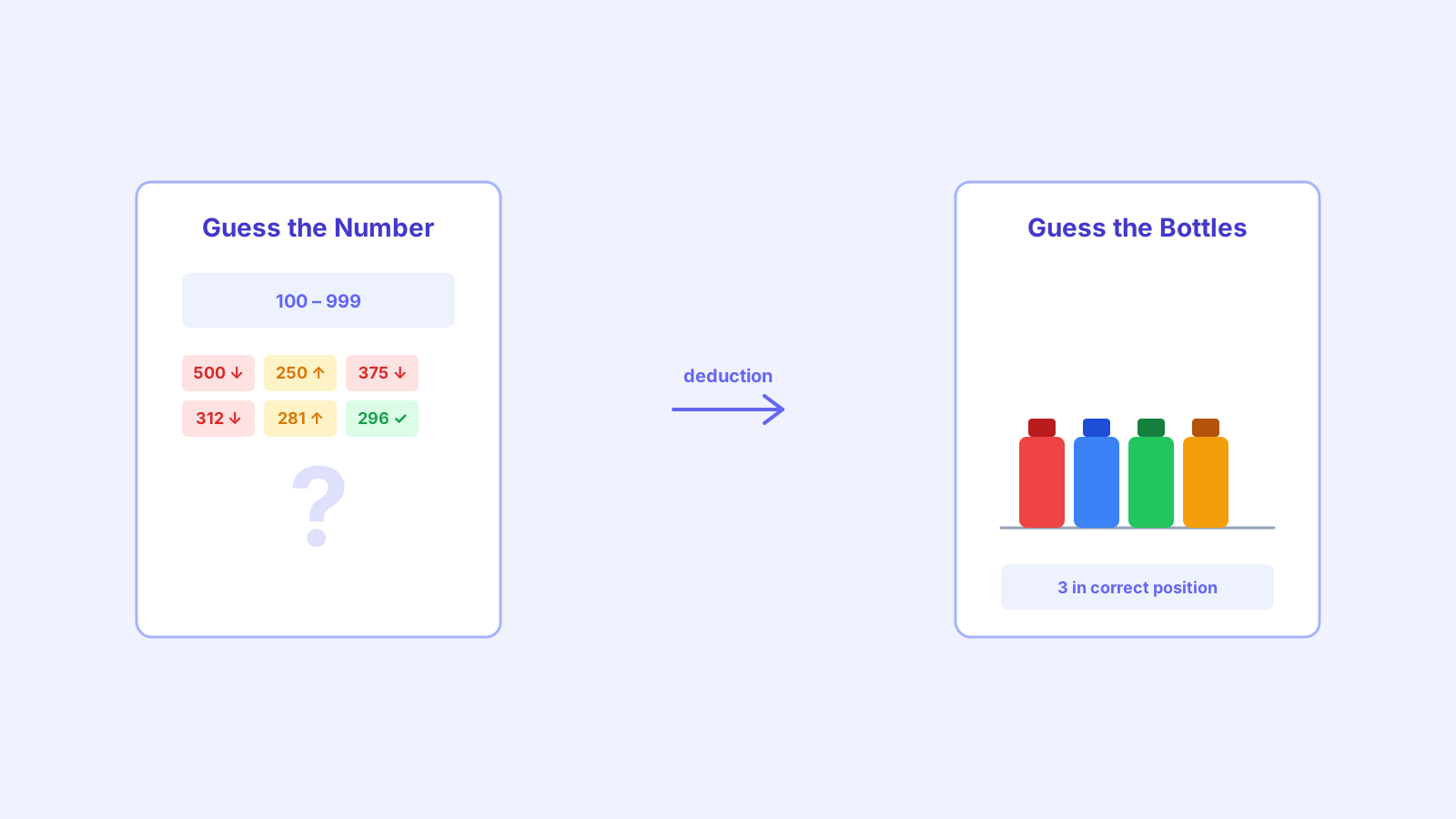
The conclusion is not avoid games. It is pick the game by the demand, not by the promise. Want to practise holding a position while things move? Focus Flash in pass-through mode does that, and does it more honestly than most working memory apps. Want visual search under time pressure? A 5×5 grid with your gaze fixed at the centre. Want step-by-step deduction? Guess the Number.
A ten-minute routine
- Three minutes of Focus Flash at 2× speed in solid mode. A round takes roughly ten seconds, so that is about a dozen reps. Stop when you miss twice in a row — that is today’s ceiling.
- Four minutes of a 5×5 Schulte grid with your gaze locked on the centre. Chase accuracy, not the clock. If your eyes start darting, slow down; the point is peripheral processing, not eye speed.
- Three minutes of Guess the Number with four digits, reasoning out loud. Saying the remaining range aloud is the part that trains updating — silent guessing lets you skip it.
Do the session after some movement, not right before bed. Ten minutes of brisk walking first is a cheap way to put the prefrontal cortex in a better state for the work.
The part nobody sells
Difficulty matters more than volume. A task you complete at 95% accuracy is entertainment. One you fail half the time is just frustrating. The useful band sits somewhere around 70–80%, where the errors are informative. Most people choose settings that feel smooth and call it practice.
Chronic stress runs the other way. Repeated stress shifts control from goal-directed prefrontal systems toward habit-based striatal ones (Schwabe and Wolf, 2011), and high noradrenaline levels can take prefrontal networks offline altogether (Arnsten, 2011). Grinding through a session while chronically stressed is not a shortcut. It is a way to rehearse sloppier habits.
So the honest version of prefrontal training is unglamorous: sleep enough, move your body, play something difficult enough that you occasionally fail, and stop while you still have attention left. The games here make that third item convenient. They will not do the other three for you.