Why Logic Games Like "Guess the Number" and "Bottles" Actually Sharpen Your Mind
Deduction games are not just time-killers. They train working memory, hypothesis testing, and the kind of constrained reasoning that shows up in math, coding, and everyday problem-solving.
Most people think of "brain training" as memory drills or reaction tests. But there is a quieter category that is just as valuable: logic deduction games. "Guess the Number" and "Guess the Bottles" look simple — one is a number hunt, the other is a color-order puzzle — but both are built on the same cognitive machinery you use when debugging code, solving a Sudoku, or figuring out why the Wi-Fi is down.
What deduction games actually are
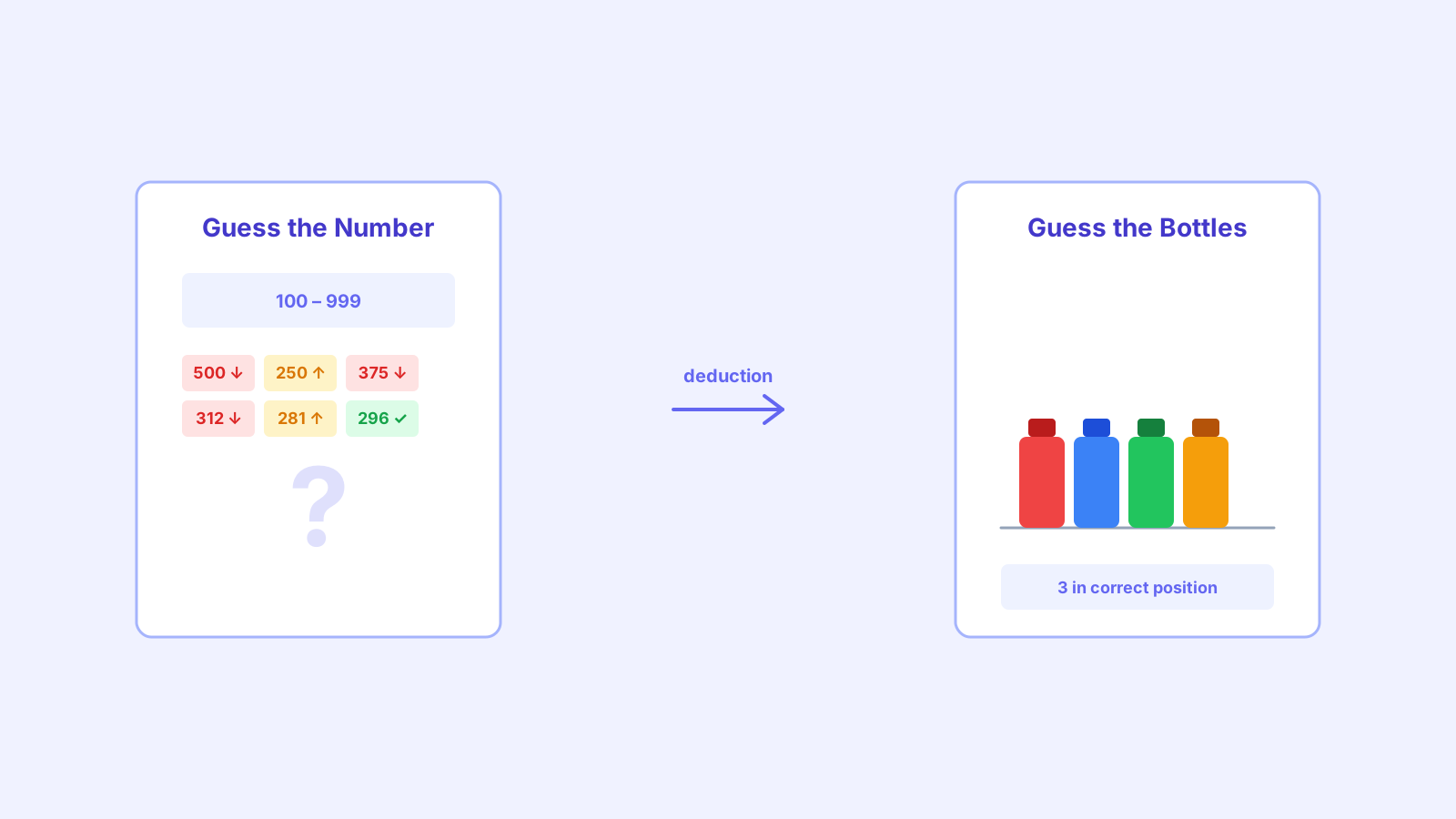
A deduction game gives you a hidden state (a secret number, a shuffled order) and a way to probe it. Each probe returns partial information — "too high," "correct position," "wrong" — and you must use those crumbs to reconstruct the full picture. The challenge is not speed; it is efficiency. How few probes can you get away with?
This is the same structure as Mastermind, Battleship, and the classic "20 Questions." It is also the structure of scientific hypothesis testing: you have a theory (the hidden state), you run an experiment (a probe), you get data (feedback), and you update your theory. The loop is identical.
What they train
- Working memory. You have to hold previous guesses and their outcomes in mind while planning the next move. With 8 bottles and 5 checks already done, that is a real load.
- Hypothesis testing. Every guess is a miniature experiment. Good players learn to make guesses that eliminate the most possibilities, not just the ones that feel lucky.
- Constraint satisfaction. The feedback creates boundaries ("the number is between 300 and 500"). You must reason inside those boundaries, not outside them. This is the core skill in math proofs and debugging.
- Pattern recognition. After a few rounds, you start to see which feedback patterns lead to fast solutions and which lead to dead ends. That intuition is transferable.
Why "Guess the Number" is secretly a math lesson
The optimal strategy for "Guess the Number" is binary search: always guess the middle of the remaining range. With a 3-digit number (1–999), that guarantees a win in at most 10 guesses. Most people discover this on their own after a few rounds, but they do not know they are reinventing one of the most important algorithms in computer science.
When a child plays this game and realizes "I should always guess the middle," they are not just getting better at a game. They are learning that structure beats luck. That is a lesson that applies to studying, to coding, to troubleshooting, and to any domain where the space of possibilities is too large to search randomly.
Why "Guess the Bottles" is harder than it looks
With bottles, the feedback is coarser: you only learn how many positions are correct, not which ones. That single number is a much weaker signal than "too high / too low," which means the game loads working memory much more heavily. You have to remember not just your current arrangement, but the entire history of arrangements and their scores.
This is closer to real-world problem-solving than most people realize. When you are debugging a system and you change three variables at once, the feedback you get is also coarse: "it works" or "it doesn't." You have to design your next test to isolate which change mattered. Bottles trains exactly that discipline.
How to get the most out of them
- Play slowly. The goal is not to win fast; it is to win with fewer guesses. Speed comes naturally as your reasoning gets sharper.
- Talk through your logic. Saying "I know it's not 4 because 4 was in position 2 last time and the score didn't change" forces you to externalize your reasoning. That is when learning happens.
- Increase difficulty gradually. Start with 3 bottles or a 3-digit number. Only move up when you can win consistently. Rushing to 8 bottles just creates noise.
These games are short — a round takes two to five minutes — and that is their strength. They are not meant to replace deep work or long study sessions. They are meant to keep your reasoning muscles warm, the same way a few push-ups keep your arms from getting soft. Do one round a day, and you will notice the difference in how you approach problems that actually matter.