The Main Types of Free Brain Training Games, Explained
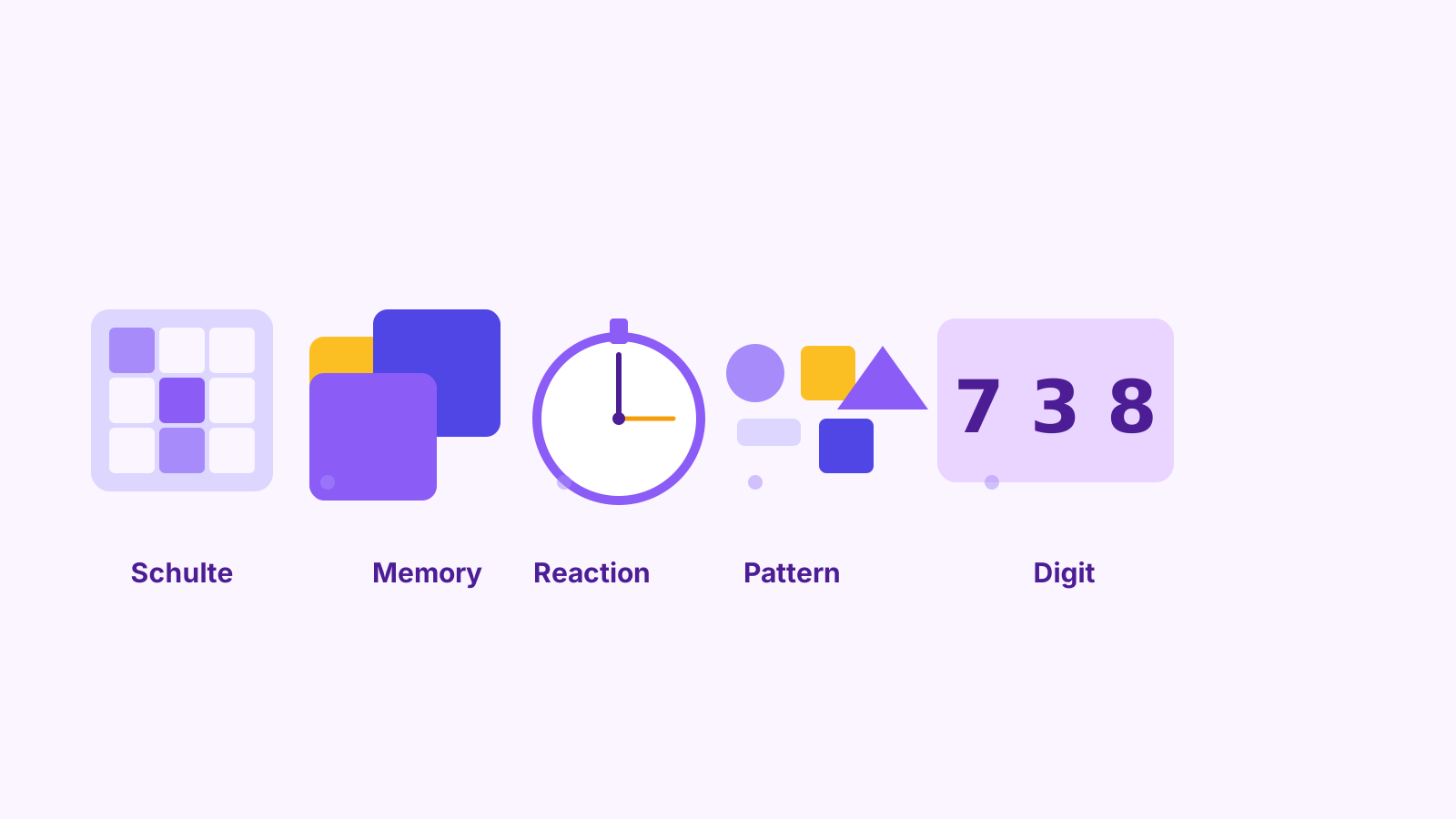
Schulte grids, memory games, reaction tests, pattern games and number games train different systems. Here is an objective map of each type — what it builds, what it does not, and who it fits.
Search "free brain training" and you get thousands of apps that all claim to improve your mind. Almost all of them fall into five mechanical families, and each family targets a different cognitive component. Knowing which is which matters more than finding the "best" one — the best game is the one training the skill you actually want.
1. Schulte grids — attention and visual search
A grid of shuffled numbers found in order, ideally with gaze fixed at center. This family trains selective attention, peripheral-field scanning and resistance to visual clutter. It does not improve eyesight or general IQ. It fits people who study screens all day (programmers, editors, analysts), athletes who need court vision, and anyone whose attention feels scattered.
2. Memory games — encoding and recall
This family splits into two sub-types. Pair-matching games (flip cards, find matches) stress visual working memory and location tracking; span games (remember a digit sequence, then type it back) stress phonological storage and attention at encoding. Transfer is narrow — a pair-matching champion is not automatically better at remembering names — but the underlying capacity they exercise shows up anywhere you must hold information and use it seconds later.
3. Reaction tests — processing and response speed
Wait-for-signal-and-respond games measure the simplest cognitive loop in psychology. Their real training value is partly the reflex itself and partly stress regulation: learning not to jump early, managing the wait, recovering from a false start. They are useful as a daily status check — sleep debt and fatigue show up in reaction time before you consciously feel them.
4. Pattern games — rule induction and logic
Sequence completion, matrix reasoning, shape-rule puzzles — this is the family closest to traditional fluid-intelligence test items. They train hypothesis testing: propose a rule, check it against evidence, discard and retry. Pattern games have the strongest claim to broad reasoning transfer, though the honest version of the evidence is that you mostly get better at puzzles structurally similar to the ones you practice.
5. Number games — arithmetic fluency and mental manipulation
Mental math, 24-style arithmetic, Sudoku-like constraint games. They train numerical fact retrieval and holding intermediate results while transforming them — a flavor of working memory with symbols attached. They sharpen calculation comfort and reduce math anxiety through exposure, but they will not make you "smarter" at unrelated tasks.
How to actually combine them
No single family covers the whole system. A sensible weekly mix looks like: attention work 3–4 times (Schulte grids), memory work 2–3 times, reaction checks daily at 30 seconds each, and one or two deeper pattern or number sessions when you have real time. Five to ten minutes a day beats a ninety-minute Sunday cram — attention and memory both respond to frequency, not heroism.
We built our free brain training games around exactly this split: a Schulte grid in five shapes, digit memory, pair matching and a reaction test, all playable instantly in the browser with no account. That is not because our games are magic — it is because the boring, honest path is to cover the five components separately, measure your own baseline, and keep showing up. Try our free brain training games and see which type your numbers say needs the work.